Original Intent is an Expert Trap
You keep being told to get back to “original intent.” But the Christianity of 1787 and the Constitution of 1787 are not the same thing — and the moment you ask what they intended, the question stops being yours.

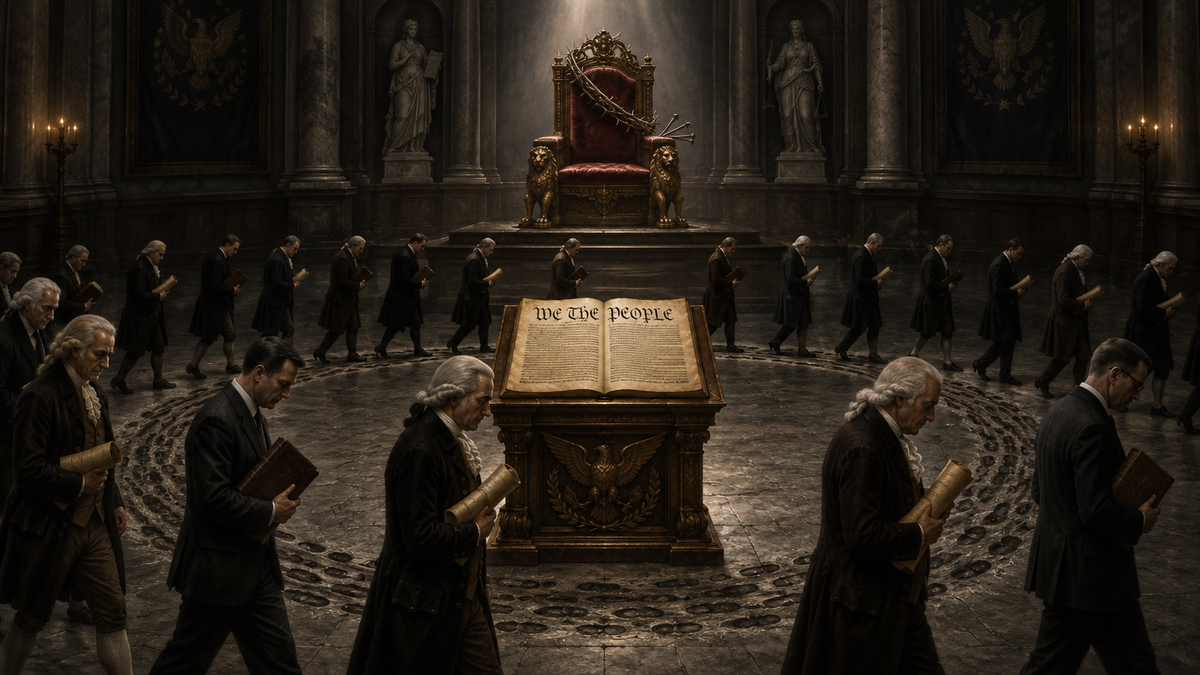
The Christianity of 1787 and the Constitution of 1787 are not the same.
TL;DR
You keep being told to "get back to original intent." That phrase confuses the Christianity of this country in 1787 with the U.S. Constitution of 1787. They are not the same thing. The culture was Christian; the charter was not. And the moment you accept "what did they intend?" as the real question, you have handed your own judgment to a credentialed class that will argue about the answer forever. The Constitution is a legal document. Read it as one. Then decide, as a Christian, what to do about it.
The Prescription You Keep Hearing
Turn on any conservative broadcast and you will hear the same remedy. The problem, you are told, is that we have abandoned the original intent of the Founders. Judges legislate from the bench. Bureaucrats invent powers. The fix is to return to what the Framers actually meant. Restore original intent, and you restore the republic.
You hear it from the think tanks, from the law schools, from the political action committees that text you for money. You heard it in every election cycle you can remember. It sounds like the answer. It sounds like the one solid thing in a world that keeps sliding.
I want to show you why it is not the answer — and why it was never meant to be.
Two Different Years
Start with a distinction that almost nobody makes clearly.
There is the Christianity of 1787. And there is the Constitution of 1787. They are not the same thing, and they do not live in the same document.
The country in 1787 was saturated with Christian faith and Christian assumption. Church attendance was high. The states had established churches or Christian qualifications for office. The charters, the state constitutions, the common law, the schools — all of it assumed the God of the Bible. Men swore oaths before Him. They buried their dead with Him. They raised their children in His fear.
Now read the federal Constitution. Look for Christ. Look for the Trinity. Look for the God of Abraham, Isaac, and Jacob. Look for the Scriptures. You will not find them. Not once. The document is not merely silent on Christian particulars. It is silent on God as such.
That silence is the point. And the gap between the culture and the charter is exactly what the "original intent" slogan is designed to hide.
The Bait and the Switch
Here is how the trick works.
You are told to honor original intent. The word "intent" sounds like it points backward — to the actual meaning of the text as the authors understood it. But intent is not the text. Intent is a claim about what was in men's minds. And the moment the argument shifts from the letter of the document to the intent behind it, something changes.
Conservatives insist on the letter of the constitutional law. Progressives insist on the spirit. The conservative elite then tells you that the real authority is the intent. But intent is exactly the "living document" move. Once meaning is whatever the authors meant rather than what the words say, the interpreter decides. The "intent" of a document that says nothing about God can be stretched to include God — by men who prefer that answer.
This is the circle. Letter, spirit, intent. Each camp grabs the handle that serves its purpose, and the debate never terminates, because it was never about the text in the first place. It was about who gets to say what the text means.
What the Signers Believed
I want to be careful here, because a great deal of wishful history is built on what the signers privately believed.
Many of the men in Philadelphia were shaped by a Christian culture so thoroughly that they saw in the new document what they expected to see. They heard Christian music where the score was blank. Some of them likely never noticed the omission. They could not imagine that the charter they produced was, in its actual terms, a godless instrument. That is a real and charitable reading of many of them.
But some men in that room knew exactly what they were doing. That is the only explanation for how such a document emerged from an assembly of Christians — a document that refuses to name God at all. Anomalies of that size are not accidents. They are choices.
I cannot prove the private intent of every man in the room, and I will not pretend to. What I can do is read the text they left, and the text is not ambiguous. Judge the document by its terms, not by the piety of the men who signed it. What it says is what it does.
"They Only Wanted to Avoid Denominational Fights"
There is one defense of the omission you will hear, and it deserves a straight answer.
The argument goes like this. The Framers were not hostile to Christianity. They simply could not agree on which Christian confession to write into a national document. Baptists, Anglicans, Presbyterians, Quakers, Congregationalists, and Catholics differed over baptism, church government, and the sacraments. Rather than take a side in those quarrels, they kept the document religiously neutral. Silence was the price of peace.
It sounds reasonable. It is not true.
A broad Christian confession would have cost them nothing. They were not being asked to choose between Baptist and Presbyterian. They could have affirmed, in the plainest terms, the one thing all of those bodies actually held in common — the Trinity, the deity of Christ, the authority of Scripture. That formula was available. It had already been used, and used by these very men, in documents of the highest national importance.
The Treaty of Paris, signed in 1783 by John Adams, Benjamin Franklin, and John Jay, opens "In the name of the most Holy and Undivided Trinity." That is a confession of the Triune God, signed by three of the most prominent Americans of the founding era, in a treaty with a foreign power. If a broad Christian confession was too divisive for a domestic charter, no one told the men who signed it abroad.
The state constitutions had already done the same. Delaware's 1776 constitution required officeholders to affirm God the Father, Jesus Christ His only Son, and the Holy Ghost — one God — and to acknowledge the Old and New Testaments as divinely inspired. That is not a denominational creed. It is the broad catholic confession, and a state wrote it into its fundamental law without splitting its churches.
And in the same year the Convention sat in Philadelphia, the Congress of the Confederation passed the Northwest Ordinance, which declared that "Religion, morality, and knowledge, being necessary to good government and the happiness of mankind, schools and the means of education shall forever be encouraged." Same era, same political class, governing the western territories. They could speak of religion's necessity for good government when it suited them. They chose not to speak of it in the charter of the nation.
So the denominational defense does not hold. If the Framers had wanted a broad Christian confession, nothing stopped them. The formula existed, the precedent existed, and the men who signed the treaty knew how to write it. What they produced instead was not silence born of disagreement. It was a silence they had the power to break and chose to keep.
And it was not merely silence. Article VI does not just decline to require a religious test for office. It forbids one. That is a positive act, not an omission. Neutrality would have left the question to the states and said nothing at all. The Framers said something: they made the exclusion of God from the qualification for office a matter of supreme law.
The Circle: Letter, Spirit, Intent
Step back and look at the shape of the argument you are in.
The conservative says: obey the letter. The progressive says: follow the spirit. The conservative elite says: honor the intent. Each one is reaching for the same thing — authority over the meaning of a document that does not say what any of them wish it said.
And because the document is silent about God, the argument about God's place in it can never be settled by the document. It can only be settled by whoever holds the interpretive throne. That is why the fight never ends. It is not a disagreement about the facts. It is a competition for the chair.
You have been invited to sit in the audience and cheer for one side of that competition. That is not citizenship. That is spectatorship with a subscription fee.
Why This Is an Expert Trap
Here is the part that matters most to you.
The instant the question becomes "what did they intend," it is no longer your question. It belongs to the credentialed class. Legal scholars will tell you what the clause meant. Historians will tell you what Madison thought in 1787 and what he thought in 1791. Theologians will tell you whether the Founders were orthodox or deist. The experts on the right will hand you one reconstruction; the experts on the left will hand you another; the Christian experts and the atheist experts will disagree, and you will be told that the disagreement is itself the answer — that the honest position is to defer.
I am not against experts. An expert who has spent his life in the sources knows more than you do about the sources, and you should use him. But expertise is a tool, not a throne. It is not a substitute for your own judgment, and it was never meant to be. You are not a spectator in a courtroom where scholars argue over the meaning of your own country. You are a man with a duty: search the scriptures to see whether these things are true (Acts 17:11). That duty was given to you. It was not delegated to a guild.
The original-intent debate does not invite you to think. It invites you to choose an expert and stop thinking. That is the trap. And it is the same trap you have been in all along: someone credentialed tells you what to believe, and you comply. You have done that before. You know what it cost.
The Machine You Have Been Defending
When "We the People" replace Christ the King, law stops being a reflection of God's character and becomes whatever the collective decides it is. The Preamble's word "ordain" is covenantal, religious language — kings were ordained, priests were ordained — and the text hands that divine prerogative to the aggregate will of men. Once the People are the ordaining power, they can ordain the protection of property today and the confiscation of it tomorrow. The seed of the administrative state is in that word.
Conservatives cling to "individual liberty" without noticing that the liberty in the founding text is a different thing from Christian liberty. Enlightenment liberty is autonomy — the absence of restraint, the right of self-will. Biblical liberty is deliverance — freedom from sin and unlawful human power in order to serve God under His precepts ("I will walk at liberty, for I seek Thy precepts," Psalm 119:45). A nation built on autonomy will always choose license over duty, and a nation of unbridled individuals always descends into chaos, at which point the state steps in as the new god to manage the wreckage. Autonomous liberty manufactures socialism. That is not a bug in the machine. It is the design.
You have been defending this machine your whole adult life, believing you were defending Christendom. You were defending the frame that made the present disorder possible.
What It Cost You
Think about what this framework cost you in your own lifetime.
When the lockdowns came, the machinery you had trusted was already in place. The emergency powers, the administrative decrees, the suspension of ordinary life by unaccountable officials — none of it required a new constitution. It required only the one you already had. You watched churches close while liquor stores stayed open, and you were told that this was lawful. It was. That is the horror of it. The godless charter was sufficient for what was done to you.
And the conservative movement that told you to revere that charter had nothing to offer but a longer argument about what the Framers intended. It could not name the authority by which your church was shut. It had spent fifty years defending the letter of a document that was silent about the King of kings.
Stop Trying to Rewind It
The original-intent remedy is nostalgia with a law degree. It asks you to return to a past that never existed in the form you imagine — a Christian nation governed by a Christian charter — when in fact the nation was Christian and the charter was not.
You cannot rewind a document that was never Christian to begin with. You can only decide what a Christian does in the country that document produced.
What to Do Instead
So here is what I would have you do, and none of it requires a credential.
Build your own house first. Your household, your church, your brotherhood of men who will actually answer for one another. Local Christian life — family worship, catechesis, the ordinary means of grace — is not a retreat from politics. It is the ground on which any serious political life must stand. You will learn the obstacles by meeting them. You will discover how colonized your own mind is by trying to think freely. That discovery is not a detour. It is the work.
Do not outsource your judgment. When a man tells you what the Founders intended, ask him what the text says. When a scholar tells you what to believe about your own country, test it against Scripture and against the plain words on the page. Use experts. Do not kneel to them.
And do not despise the stronger voices that may come. A movement, a leader, a man who can clear the mental cobwebs — these may become necessary as more men wake up to what they have been defending. You do not need to understand every antecedent to begin. You need to begin.
The Question
The question is not "what did they intend." The question is: by what authority does any man rule you, and does that authority answer to Christ? The Constitution of 1787 does not answer that question. It was built to avoid it. You are not.
Suggested Reading
If you want to go further, these will repay the time:
- The United States Constitution — read the actual text, especially Article VI
- Delaware Constitution of 1776, Article 22 — the broad Christian confession a state was willing to write
- The Treaty of Paris, 1783 — the Trinitarian opening signed by Adams, Franklin, and Jay
- The Northwest Ordinance, 1787 — religion, morality, and knowledge as necessary to good government
- Doug Wilson, Mere Christendom
- Stephen Wolfe, The Case for Christian Nationalism
- The Anti-Federalist Papers (Patrick Henry and "Brutus")

If this one landed, the next one will too.
Get new essays free, directly to your inbox.
Your response has a place here. Enemies of freedom do not.
Stay in the airlock →