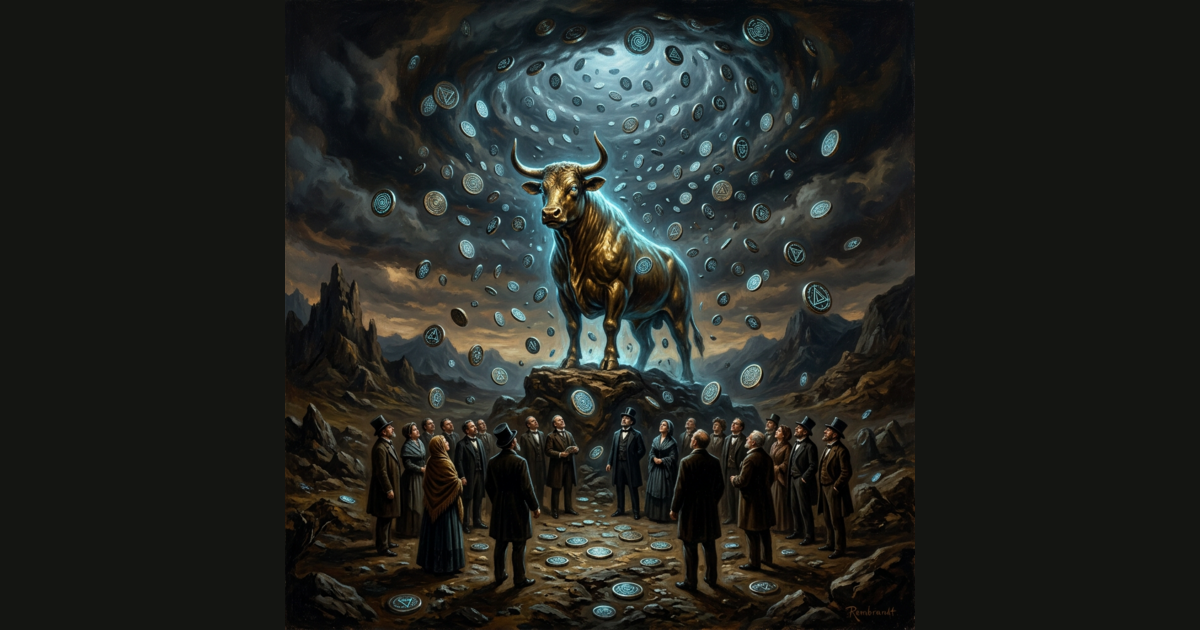
BitCalf: The Digital Idol
. . . Bitcoin would become — . . .connected to the most extensively documented criminal and blackmail network of the modern era.

Outline
Alex Newman and Aaron Day did the hard work. Their interview for The New American traced the money, named the players, and mapped the timeline — the kind of primary-source journalism that takes years to assemble and requires the courage to publish. What follows is a distillation: the same architecture, stripped to its frame, so that a man with a long day behind him can read it once and know what he needs to know.
What they documented is worth your attention — not because it will make you angry, but because it will make certain things about the last decade suddenly make sense. The exits were real. The hijacking was also real. And the two facts belong together.
🔧 The Mechanism
Most men who looked seriously at Bitcoin between 2010 and 2017 were not gamblers. They were engineers, tradesmen, and producers who had watched the dollar lose its value year after year, watched banks get rescued with public money after making catastrophic private bets, and watched the rules bend reliably in favour of the people writing them. They were looking for a door out — and what appeared in October 2008 looked like one.
The document that launched Bitcoin made a simple promise: you can send money directly to another person, anywhere in the world, without a bank in the middle and without anyone's permission. No account required. No institution holding your funds, lending them out, and charging you for the privilege. The supply of coins was fixed by mathematics — unlike a dollar, which a government can print in unlimited quantities. This was not a fantasy. The technology was real. The promise was structurally sound. And for a time, it worked roughly as described.
Then the rules changed. Not visibly. Not with an announcement. But between 2015 and 2017, a fierce internal argument about how Bitcoin should work was settled — and it was settled in a direction that transformed Bitcoin from a payment system into something much more like a commodity you buy and hold. The version that could have been digital cash — money you spend, privately, between two people — lost. What remained was repositioned as "digital gold": something institutions would accumulate, trade, and sell exposure to, just like any other financial product. By 2020, corporations were putting hundreds of millions of dollars into it as a balance-sheet asset. By 2024, the largest investment banks in the world were offering Bitcoin products to their clients.
Listen to the language. Hear the machinery inside it.
"Bitcoin is digital gold."
Gold you can spend freely is money. Gold that sits in a vault, managed by institutions, with your access depending on their rules — that is an asset class. The moment Bitcoin became "digital gold," it stopped being a payment system for working men and became a vehicle for the same financial industry it was built to bypass. That was not an accident of market forces. It was the outcome of a deliberate argument about design — an argument that was funded by specific people with specific interests."Crypto gives you freedom from the banking system."
The coins themselves may sit on a network no single government controls. But to get money in or out — to turn your wages into crypto, or your crypto back into rent money — almost everyone used the same kind of company: a licensed exchange, operating under government rules, that required you to hand over your name, your identity documents, and a permanent record of every transaction before they would let you through the door. The coins were free. The on-ramp and off-ramp were not. And most people never noticed the difference until it was too late."It's trustless — you don't need to trust anyone."
The underlying mathematics requires no trust. But the companies built on top of those mathematics — the exchanges, the custodians, the platforms — required exactly the same trust as a bank, with fewer of the legal protections. "Trustless" described the code. It did not describe the world men actually lived in when they tried to use it.
The thing that was sold as a way out of Wall Street became Wall Street's newest product line. That is not a theory. That is the documented sequence of events, publicly available, reported in the financial press without apology.
🎯 Their Objective
Ask the straight question: if this were genuinely a tool for financial sovereignty, why did the funding of its core development — the small group of programmers who controlled the code — flow toward the most credentialed and connected institutions in the country, and not toward the men using it?
In 2015, as the original Bitcoin Foundation ran out of money, the MIT Media Lab launched a program to employ the developers maintaining Bitcoin's code. The man running the MIT Media Lab at the time was Joi Ito. Documents subsequently released by the Department of Justice confirmed that between 2013 and 2017, Jeffrey Epstein — whose name you know — donated over half a million dollars to the MIT Media Lab, with money directed toward exactly that program. Ito resigned in 2019 when the connection became public record.
The men who made the decisions that determined what Bitcoin would become — decisions about design, capacity, and direction — were, during those years, employed at an institution funded in part by money connected to the most extensively documented criminal and blackmail network of the modern era. Draw your own conclusions about causation. The sequence of events is not disputed.
Listen for the dismissals. They are not explanations. They are pressure.
"The price went up — what does it matter who funded the developers?"
It matters because the decisions made during those years shaped what Bitcoin became. The argument that kept Bitcoin from functioning as everyday money — and turned it instead into something you hold and speculate on — was decided by the people whose salaries were being paid. Who pays the people who make the decisions is not a conspiracy theory. It is the most basic question in any organisation. Apply it here as you would apply it anywhere else."The surveillance tools just help catch criminals."
Every transaction on the Bitcoin network is permanently recorded, in public, forever. The record does not have names on it — until the moment you use a licensed exchange, at which point your name is attached to your transaction history going backward and forward from that point on. A growing industry of companies was built specifically to do this matching — and those companies hold contracts with federal law enforcement agencies. The tool catches criminals. It also catalogues everyone else. Those are not separate outcomes. They are the same product, sold to the same customers."The big investment funds just give ordinary people access."
When a major bank sells you a Bitcoin investment product, you do not own coins. You own a piece of paper — a financial instrument — that tracks the price of coins the bank holds on your behalf. You cannot spend those coins. You cannot move them. You cannot hold them in your hand or in an account you control. You have purchased exposure to a number on a screen, managed by the same custodians and institutions you were trying to leave. Access to the price is not the same as ownership. The product gives you the first and eliminates the second, quietly, in the fine print.
The objective, read in aggregate: identify every man who wanted out, get his name attached to his holdings the moment he touched licensed infrastructure, route his savings through regulated companies, and retain the ability to freeze, seize, or restrict his access at will. Not to destroy the tool. To own it — and to own everyone using it.
💸 The Cost to You
This is not abstract. The cost has a specific shape — and it is worth naming clearly, because part of what was taken was taken so gradually that most men did not notice until it was gone.
The first cost was direct. Every man who bought coins through a licensed company handed over a permanent record: his name, his government ID, a log of every purchase and sale. That record does not expire. It sits in a database, available to government agencies by legal request, indefinitely. He paid for the promise of financial privacy with the complete elimination of it. The record of his attempt to exit the system became part of the system's file on him.
The second cost was deeper. Consider what was done with ten years of a generation's attention and savings. The man who would have organised a local trade network, built a relationship with men he trusted, put money into land or tools or a skill that produces something real — that man spent five years instead watching a price chart and arguing about which coins to buy. The system that was squeezing him did not need to suppress his instinct to build something parallel. It needed only to redirect that instinct into speculation — and it succeeded, not through force, but through an offer that looked exactly like what he was looking for.
And then there was Canada. In February 2022, the government moved against truck drivers who had parked in Ottawa to protest the mandates. Some of those drivers and their supporters had accepted donations in Bitcoin, believing it was beyond reach. The government issued orders to licensed companies to freeze specific accounts — and those accounts were frozen instantly, without a court order, without a hearing, without warning. Whatever those men held through a company was gone with a phone call to a compliance department. What some held in coins they controlled directly, without any company in the middle, proved harder to reach — and accounts suggest a meaningful portion did evade the freeze. The lesson is precise: anything you hold through their infrastructure, they can reach. Anything you hold yourself, in your own hand, they must work much harder to touch. They do not hate the idea of Bitcoin. They hate Bitcoin that you actually control.
You didn't sign up to be catalogued. You signed up for a way out. The system converted the exit into an entrance — and did it one signup form at a time, while you were busy trying to build something. That is not your failure. That is the mechanism. Naming it is the first act of reclaiming the ground.
⚡ Exercise Your Free Will
You are not going to rebuild a parallel economy tonight. That is not the job tonight. The job tonight is making the mechanism visible — to yourself, and to one man you trust who has not seen it yet.
Outside work. With men you trust. No accounts, no records, no flags.
"Do you actually hold your money yourself, or is it sitting in someone else's system with your name on it?"
That is the opener. It is casual. It is the kind of question one man who understands how things work asks another. No signal. No manifesto. And what happens next is that the other man — who has been carrying the same vague unease — either says "I don't know" and starts thinking about it, or names the company where his savings are sitting and suddenly hears himself say it out loud for the first time.
You are not writing a newsletter. You are not filing a comment. You are mustering — turning a quiet conversation with a trusted man into the moment where two men who have been separately sensing the same thing realise they have both been seeing it. That moment of recognition is worth more than any published argument. A published argument produces clicks. A conversation between two working men outside the system produces nothing the system can measure, manage, or monetise.
The question is the sovereignty. You are not asking for permission to be right. You are naming a mechanism — and the mechanism loses power the moment it is named between two men who trust each other.
The architecture of the capture is clear. But naming the mechanism is only half the task. We must now turn to the far more difficult work: recovering the identity that was never theirs to define, and tending to the household you are actually responsible for.
The Sovereign Reality
There is a story in scripture the financial system would prefer you read as children's material and move past. Israel had just escaped Egypt — an administrative empire that numbered its labourers, assigned their quotas, and managed their lives from the top down. They were free. And within weeks, they melted their gold into the shape of a calf and called it their deliverer.
"These are your gods, O Israel, who brought you up out of the land of Egypt." — Exodus 32:4
They were not stupid men. They were not defective men. Moses had been gone forty days. The silence was real. The fear was real. And then they chose. They chose to melt the gold. They chose to shape the calf. They chose to dance. The Bible does not present this as a breakdown or a trauma response — it presents it as sin, which means it was a decision made by men who knew better and did it anyway. That is not a comfortable reading. It is the only honest one. A God who holds men accountable for their choices must believe those men had choices to make. We are not defective washing machines running a bad programme. We have wills. And the will can be pointed at an idol just as freely as it can be pointed at the truth.
That is the precise mechanism. You do not need to have bought a single coin for this to be your story. The offer was made to an entire generation: the system is corrupt, the dollar is being debased, the banks are rigged — but here, we have built you something outside all of that. Something mathematical. Something they cannot touch. Men who were right about every one of those grievances reached for it. The fear was legitimate. The grievance was legitimate. The choice to trust the substitute rather than do the harder work of building something real — that part was not forced on anyone. That part was a decision. And the Bible insists we name it as one, because only what is honestly named can be honestly repented of and left behind.
Moses came down the mountain and saw what had happened. He did not call a meeting. He did not write a rebuttal. He did not ask the calf for its whitepaper.
"And it came to pass, as soon as he came nigh unto the camp, that he saw the calf, and the dancing: and Moses' anger waxed hot, and he cast the tables out of his hands, and brake them beneath the mount. And he took the calf which they had made, and burnt it in the fire, and ground it to powder, and strawed it upon the water, and made the children of Israel drink of it." — Exodus 32:19–20
Read that slowly. He burnt it. He ground it to powder. He made them drink it — made them taste, in their own mouths, what they had put their hope in. There is no gentleness here. There is no committee. There is a man who knows the difference between the real thing and a substitute, and who refuses to pretend the substitute is acceptable because people got emotionally attached to it.
That is what the moment asks of you now. Not rage — rage is just another distraction. But the same clear-eyed, decisive recognition: this was not what it was sold as. The digital gold is not solid. When the truth comes out — and it comes out in pieces, which is how these things always work — the man who placed his hope in the number on the screen is left with the bitter taste of his own deception. That is not cruelty. That is reality. Moses made them face it because a man who has swallowed a lie must know what he swallowed before he can walk forward straight.
The Christian man has a different relationship with money than the system assumes. He is not against wealth. He is against idolatry — against placing in any created thing the trust that belongs to the Creator. He does not trust the dollar. He does not trust the algorithm. He does not trust the institution. He is a faithful steward of what he has been given — land, labour, relationships, time — and he knows that what cannot be frozen, seized, or inflated away is not held in any company's database. It is held in covenant.
You do not need a more secure wallet. You do not need a better platform or a smarter strategy for the next cycle. You need to break the idol, walk away from the casino, and go back to the work that God actually blessed — work that produces something real, that feeds someone, that builds something that lasts. The system can freeze your account. It cannot freeze your skill, your land, your community, or your covenant. Those are not on their ledger.
They have the infrastructure. We have the Great I AM.
"Little children, keep yourselves from idols. Amen." — 1 John 5:21
A Prayer for the Living
Lord, we thank You that our security does not come from a price chart or a protocol. We confess that we placed our hope for escape from an unjust system into tools that could not bear it — and we chose to do so. The longing for sovereignty was right. The fear was real. And we chose the substitute anyway. We are not asking You to excuse the choice. We are asking You to forgive it — which is a different thing entirely, and the only thing that actually clears the ground. Forgive us for the years spent watching tickers when we should have been building. We do not ask to be free from the consequences of the world we live in — we ask for the courage to choose rightly when the silence gets long and the fear is real. Help us to be faithful stewards of what You have actually given us: our hands, our skills, our families, and the men beside us. Remind us that what belongs to Caesar is already defined — and the rest belongs to You. And remind us that no administrative state, however sophisticated, has ever successfully managed a man who knows whose he is. Until You call us home, we are Yours — not theirs. Amen.
A Briefing for the Household
Do not let this stay on the screen. This week, gather your household — whether that is a house full of children or just yourself at the table — and read these three passages together:
Exodus 32:1–20: The golden calf — built by free men, from their own gold, in a moment of fear and silence. Read it to the end this time. Do not stop at the dancing. Read what Moses did when he came down the mountain. Ask your household: what does a man do when he realises he has been played by a lie? He does not negotiate with the lie. He names it, breaks it, and moves forward. That is not anger. That is leadership.
Exodus 3:14: God's self-naming to Moses, sending him into Pharaoh's system. Read it and teach: your identity comes from the Great I AM, not from any system that claims to manage you. When someone — an institution, a platform, a government — tries to tell you that your wealth is what they permit you to hold, you answer with the Name. "I AM sent me."
Proverbs 11:1: "A false balance is an abomination to the LORD, but a just weight is his delight." Read it and teach: God cares about honest money. He always has. The debasement of the currency, the manipulation of markets, the promises that turned out to mean something different than advertised — these are not technical financial matters. They are moral ones. Teach your children that a man who insists on honest weights is not being difficult. He is being faithful.
Teach your children the difference between the system's "security" and God's provision. The system says: your wealth is what we permit you to access. Your freedom is what we have not yet restricted. God says: you are Mine, and I AM is My Name. Teach them that a man who knows whose he is cannot be managed into forgetting it — because the system can change his account balance, restrict his access, add new conditions to his compliance — but it cannot change the Name that sent him.
When you look at the screen, don't let it define you. Remind your house: they have the infrastructure, but we have the Great I AM. And the Great I AM does not manage. He redeems.


If this one landed, the next one will too.
Get new essays free, directly to your inbox.
Your response has a place here. Enemies of freedom do not.
Stay in the airlock →